
The Tech-Forward Director’s Guide to Running a Live Film Set
July 5, 2026
July 5, 2026
The first day on set rarely goes as planned.
You arrive with a storyboard you trust—frames carefully composed, sequences mapped, pacing imagined down to the second. On your screen, it all made sense. It was controlled. Predictable.
Then reality steps in.
The light cuts differently across the room. The location feels tighter than expected. An actor instinctively moves in a way that changes the shot’s energy. What looked perfect in pre-production suddenly needs to be rethought.
And now, instead of directing, you are adapting—flipping through printed pages, marking up PDFs, pulling your team into small circles around a glowing screen.
The vision is still there. But it is harder to hold onto.
Modern filmmaking is no longer limited by imagination. It is limited by how quickly that imagination can move.
A storyboard should not feel like a record of decisions already made. It should feel like something you can still shape.
On set, a frame is not just an image—it is a conversation between movement, timing, and space.
When you block a scene, your crew needs to know more than just where the camera is. They need to feel where it is going.
A subtle push forward. A slow pan that reveals tension. A shift in framing that changes the meaning of a moment.
These are not details you want to explain repeatedly. They are things you want to show—instantly, visually, without friction.
With a modern, browser-based storyboard, the frame becomes flexible:
With StoryBoom, a camera move can appear on the canvas as quickly as you think of it. No pause. No explanation spiral. Just clarity.
And that clarity travels—across your DP, your camera operator, your entire team.
There is a quiet disconnect when your storyboard lives on a device.
Filmmaking, after all, is physical. It lives in space—in the distance between actors, in the height of a light, in the angle of a lens.
So why does the plan stay trapped in a laptop?
Now imagine something different.
A wall inside your studio becomes your storyboard. Frames stretch across it, large enough to be read at a glance. The next shot is not hidden in a file—it is present in the room.
Your lighting crew looks up and immediately understands the tone.
Your actors glance over and sense their framing before stepping in.
Your producers track the day not through spreadsheets, but through images unfolding in sequence.
The storyboard stops being a document. It becomes part of the set itself.
Because StoryBoom is fully browser-based and responsive, it scales effortlessly—from the phone in your hand to the wall in front of your entire crew.
One workspace. No translation required.
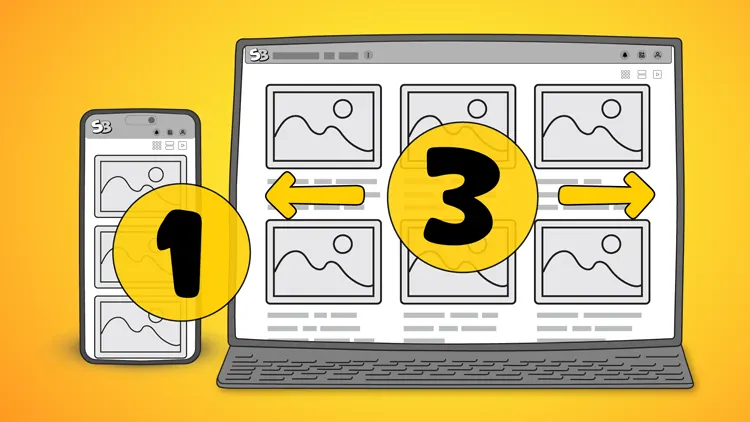
StoryBoom on: smartphone and tablet
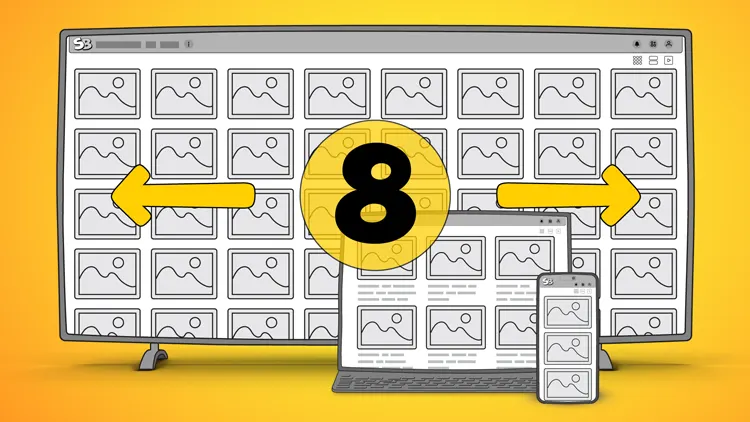
StoryBoom on: wide screen monitor
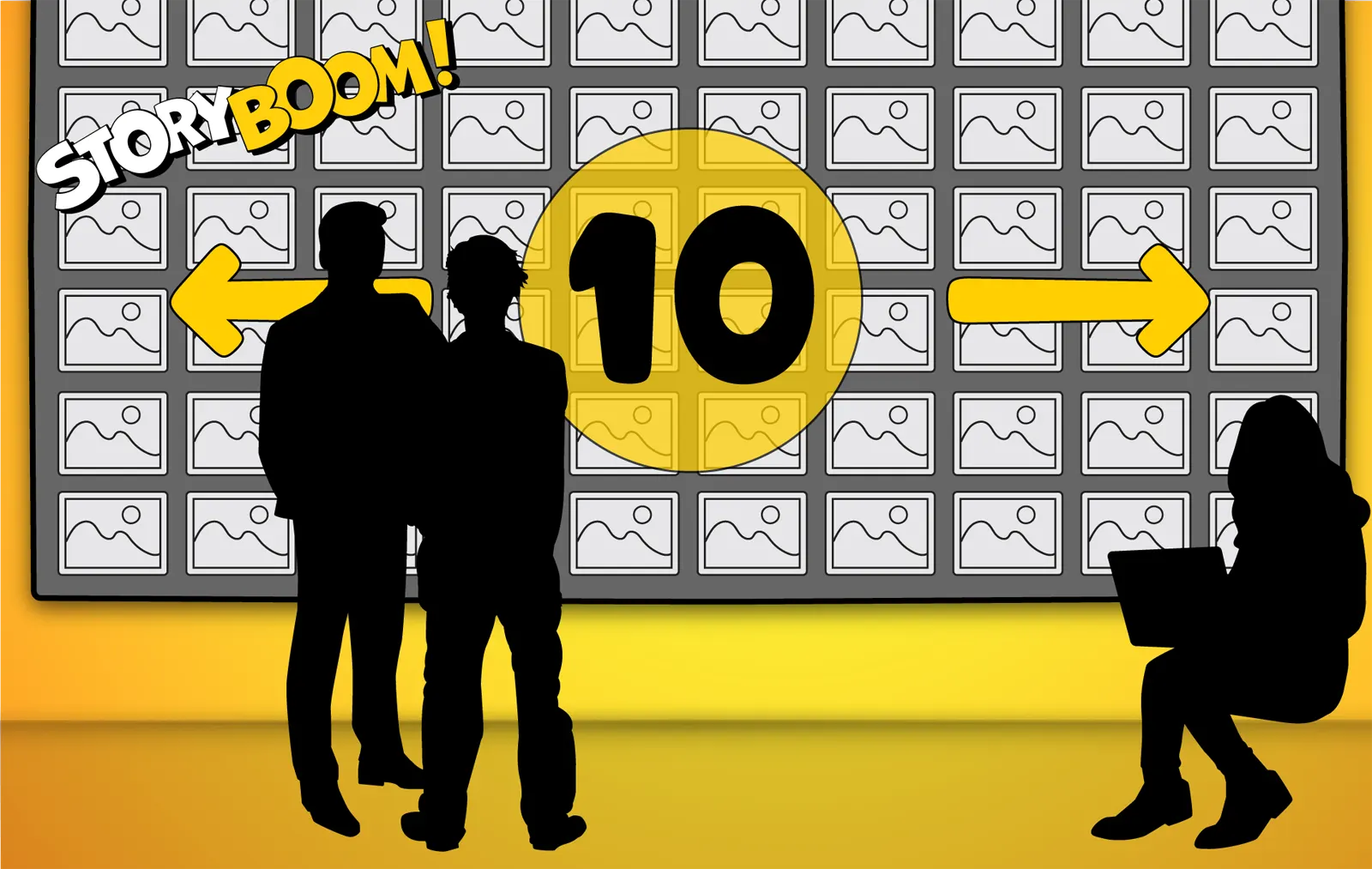
With StoryBoom, your storyboard can fill even the largest display, showing up to 10 images in a row.
On a live set, misalignment is rarely dramatic. It is subtle.
A small change that does not reach everyone.
A note that gets lost between departments.
A decision that exists in one place, but not another.
These are the moments that slow a production down—not because people are not skilled, but because they are not seeing the same thing at the same time.
A live storyboard changes that dynamic.
When every department shares the same canvas:
An assistant director adjusts a sequence. The change appears instantly. A DP reframes a shot. The new intention is immediately clear. An editor, miles away, sees the same structure forming in real time.
For example: a wide shot shifts to a tighter composition during rehearsal. The update is made on a tablet, and within seconds, the entire set—from wall display to handheld devices—reflects the new plan.
No reset. No confusion. Just continuation.
This is what it feels like when a production moves as one system instead of many parts.
Directing is not just about making decisions. It is about preserving momentum.
The longer it takes to communicate an idea, the more it loses its edge. The more the set pauses, the more energy dissipates.
The right tools do not just organize your work. They protect that momentum.
StoryBoom is built with that principle in mind:
And because it runs entirely in the browser, it is always available—on any device, in any location, at any stage of production.
No installs. No friction. No delay between idea and execution.
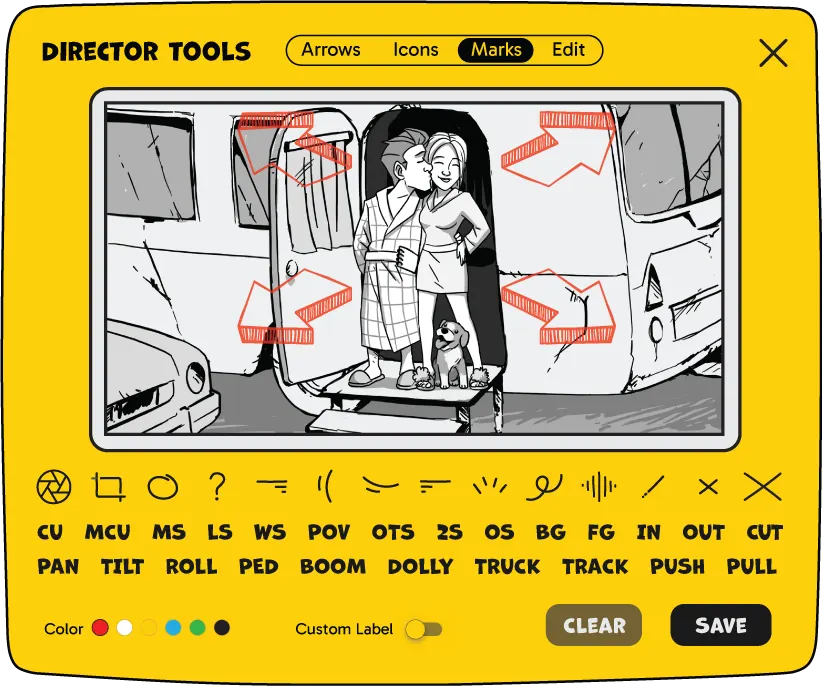
Enhance your storyboard with camera moves, arrows, symbols, cues, and editable text labels.
Every film begins as something fragile—a collection of images, instincts, and possibilities.
The challenge is not just creating that vision. It is carrying it, intact, through the unpredictability of production.
The tools you use will either slow that process down—or allow it to flow.
If you are ready to move beyond static storyboards and into a workspace that evolves with your set, StoryBoom gives you that flexibility.
Start your next project for free. Build up to 80 scenes. Share it with your team. Bring it onto the wall. Let it change as your film changes.
And most importantly—keep directing, without interruption.

Stay connected—follow StoryBoom on X or LinkedIn
Back to Blog